ou shipped more this quarter than in any quarter of your career. The dashboards are green. Your team moves faster than it ever has. Decisions that used to take a week now take a hallway conversation, and you make twenty of them before lunch.
Is this you?
If it is, you've done the thing — you've put AI to work and crossed into a level of output that looked impossible eighteen months ago. If it isn't yet, you're standing where most of the market still stands, and what follows is a postcard from a little further down the same road. Because this is the year we've been living at Orange Hill: we automated the work that could be automated, and productivity — the problem everyone is still trying to solve — quietly stopped being the problem.
I want to tell you what's on the other side of that, because almost no one is. Solving productivity doesn't deliver you to rest. It delivers you to a different, stranger problem — a better one, the kind you only get to have once the automation works. And most people haven't reached it for a simple reason: you can't hit this wall until you've cleared the first one.
Here's the wall.
I run five to seven projects in parallel right now. AI handles most of what used to fill my day — the building, the drafting, the wiring-together. I know the human half hasn't been automated, so I guard it: I schedule thinking time, I've built a workflow around deciding deliberately instead of on reflex. I'm not flying blind. The problem is subtler than that, and more frustrating. I've simply run out of enough of the one kind of time the machines can't hand back — the slow, undivided thinking a real decision needs. Everything around it scaled. That didn't.
That's the feeling underneath the green dashboards. Not that you're behind — that you've become a router. Every input processed; nothing truly considered. The fatigue doesn't come from doing too much. It comes from deciding too much, too fast, on too little thought.
The Bottleneck Was Never Execution
In Thinking Without Words I argued that the real bottleneck in knowledge work was never execution — it was the substrates underneath. What you know. How you think. What you care about. AI turned out to be the proof. The moment it could execute, we discovered execution was never the scarce thing.
Here's the part nobody warns you about. When execution stops being the constraint, you become the constraint. Specifically, your judgment does.
And judgment has a property that execution doesn't: it doesn't parallelize.
You can run five agents writing code at once. You can have three documents drafting themselves while you sleep — I do; I named one of them Nikola Tesla. But you cannot run five good decisions at once inside one head. Decisions are serial. They demand the one resource that doesn't fan out across machines: your undivided attention, held on a single thing, long enough for the thing to resolve.
The automation that made parallel execution free quietly created a serial bottleneck. And the bottleneck is you.
This is not a downgrade. It's a promotion. Automation clears the cheap, repeatable work off your desk until the only thing left is the work that was always the actual point — judgment, taste, the call only you can make. If you haven't felt this constraint yet, that's the tell: you simply haven't automated enough for judgment to become the thing that binds. The wall isn't a warning to slow your adoption. It's the destination of it.
What AI Actually Took From You
Here's the subtler loss, and it took me a while to see it.
AI didn't take the work. It took the latency.
Think about what it used to cost to turn an idea into a real thing. Days. Sometimes weeks. That delay felt like friction — the enemy of progress. But it was secretly doing a job. While the idea waited to be built, it kept living in your head. You'd return to it on a walk. Turn it over. It would sharpen, evolve, sometimes quietly collapse before you wasted a month on it. An unbuilt idea is still fluid.
Now the gap between idea and artifact is twenty minutes. And because building is free, nothing has to wait. You crystallize on version one — because version one is suddenly cheap. The idea never gets the chance to mature, because maturing used to happen for free, in the gap, and the gap is gone.
This is the hidden tax of speed. The most dangerous thing AI handed us isn't the ability to build fast. It's the ability to build the wrong thing fast — and then have the wrongness baked into running code instead of sitting harmlessly as a half-formed thought.
When I was twenty, with all the time in the world and almost no ability to execute, my ideas were better. Not because I was smarter. Because they were forced to incubate.
The Highway
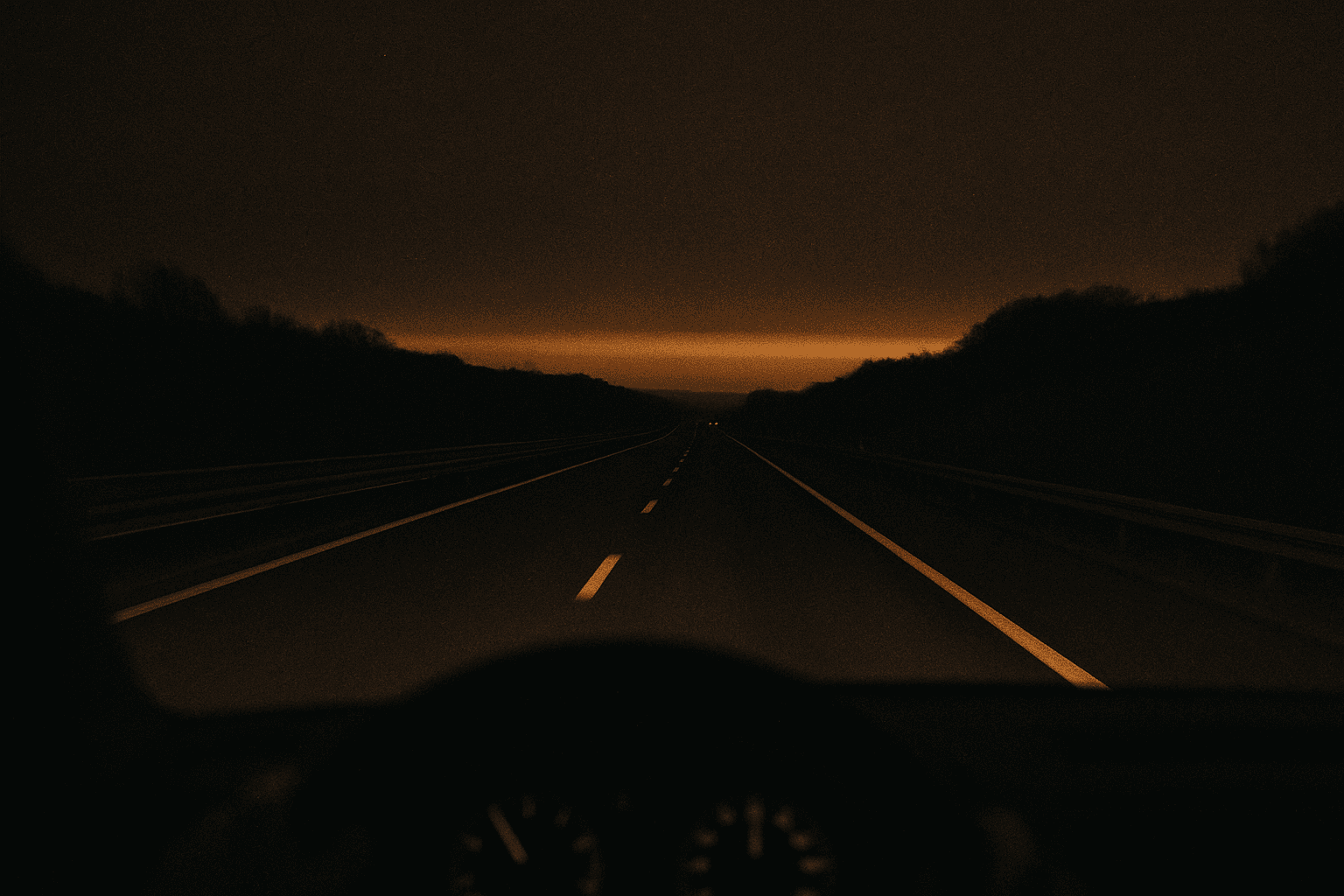
There's exactly one place left in my life where the old conditions still exist. The highway.
Belgrade to Vienna. Belgrade to the coast. Ten hours in which something strange and reliable happens: the best thinking I do all month. Not because driving is magic — because of what driving forbids and permits at the same time.
It occupies just enough of me — the motor task, the road — to keep the busy, executive part of my mind quiet. But it leaves the rest free to wander. Neuroscientists call that wandering part the default mode network, and it's where insight actually comes from. It switches on only when you stop directing attention. Focused work suppresses it. The highway is one of the few environments that loads your hands and frees your mind in the same moment.
It also removes optionality. I can't act on a thought — there's no screen, no Claude Code, no Slack. So the thought is forced to mature instead of being immediately emptied into an editor. No one is asking me anything. One task. No context-switching. A temporal container — ten hours, I know I'm in here — which paradoxically releases the urgency that kills deep thought.
Monotony. No decisions. A closed container. A mind pre-loaded by the conversation in hour one. Those are the textbook conditions of incubation, and the highway delivers all of them by accident.
“I gave that posture to the machine. And somewhere along the way, I stopped keeping it for myself.”
Here's the irony I couldn't ignore. I named my assistant Nikola Tesla because Tesla ran his machines in his head — built them in his imagination, let them turn over for weeks, stress-tested them mentally, and reached for tools only once the thing already worked. The hardware was confirmation.
I gave that posture to the machine. And somewhere along the way, I stopped keeping it for myself.
The Shape of It: Load, Incubate, Commit
When I started protecting time for this — an hour, door closed, notifications off, one project only — it helped. But something still drained me, and it took a while to name.
I'd been trying to do three different things in a single sitting, and two of them don't belong in the same room.
A decision really has three phases. First you load — pull in the relevant information, the context, the constraints, and press them into your mind until the problem is fully held. Then you incubate — you let it go, and your mind keeps working it without you. Then you commit — you make the call and hand the execution to the machines.
The load and the commit are convergent, bounded, a little pressured. They belong in a focus block; that's exactly what a block is good for. But the middle phase is the opposite. Incubation is loose, diffuse, unhurried — it is not something you can grind out at a desk with the clock running. Try to force the figuring-out into the same pressured hour where you loaded the problem, and you're cramming diffuse-mode work into a convergent container. That's the combination that exhausts you, and it produces a shallow answer.
So I stopped treating the block as the place where the thinking happens, and started treating it as the two ends of the thinking. The block is where I load the mind — and, later, where I pull the trigger on what already matured. The part that produces the good answer happens in between, in idle time, when I'm nowhere near a screen.
That's the whole discipline. You load deliberately. You let it incubate on purpose, in protected idle time. Then the deciding is fast — because the thinking is already done.
The Practice
So here is what I'm actually doing about it. Four moves, in order of leverage.
Cut the parallelism before optimizing anything else. Five-to-seven projects with scattered attention produces fewer good decisions than two or three held with full presence — even if more lines of code come out the other end. More output, worse judgment, is a bad trade for anyone whose job is now mostly judgment. So the first question on every project is brutal: is this real, or am I keeping it open only because keeping it open is cheap now?
Reintroduce latency on purpose. A new idea no longer goes straight into the build. It goes into a holding period — 24 to 48 hours — precisely because it no longer has to. The thing AI took, I'm putting back by hand.
Keep a decision log per project. The real tax of running many threads isn't the work; it's the reload cost — reconstructing where each project's reasoning stood when I last left it. A few lines per project (what I decided, why, what I deferred, what I'm still unsure about) collapses a twenty-minute re-derivation into a two-minute read. It also makes incubation portable: I can prime a project on the highway because I actually remember its open questions.
Schedule the incubation — don't leave it to the highway. The drive works because the conditions are imposed on me. The discipline is to engineer those same conditions on an ordinary Tuesday: a familiar walk, the phone in another room, the problem loaded beforehand. Don't wait for a ten-hour drive to do your thinking for you.
The Half Nobody Puts on a Slide
This is the quiet shift underneath the agent era. The work is leaving. The deciding is staying. And the deciding needs something the machines can neither supply nor accelerate: a mind that has actually sat with the problem.
The slow way builds something that holds. I wrote that last month about infrastructure — that wiring things together quickly and hoping is faster, right up until it isn't, and the durable system is the one you built deliberately. The same thing turns out to be true of decisions. The ones you race through don't hold. The ones you let mature do.
Tesla had it right. Think the thing all the way through, in the place where thinking is free. Then reach for the tools.
The machines do the reaching now. Our job is the thinking — and protecting the quiet it requires.
At Orange Hill, we build the automation — that's the on-ramp, and if you're not on it yet, that's where we start with you. But we build it knowing what waits on the other side: the half of the transition nobody puts on a slide. Everyone wants the automation. Almost no one designs for what's left once it works — the human, holding the decisions, needing room to think. That room is now the most valuable thing on your calendar.
Defend it.
Comments
No comments yet.