esterday afternoon, I had to pay an invoice from an Austrian company by close of business. To my horror, the document didn't have a QR code. Just plain text instructions—bank, account number, reference, amount. The kind of thing that takes ten careful minutes of typing into a banking app, with a single misplaced digit ruining the transfer.
I forwarded the PDF to my AI assistant. Asked him to generate a QR code my mobile banking app could read.
A minute later, the code came back. I scanned it, the app filled itself in, I confirmed, the invoice was paid.
That was the entire interaction. Ten seconds of attention from me. The rest happened on a machine in another room.
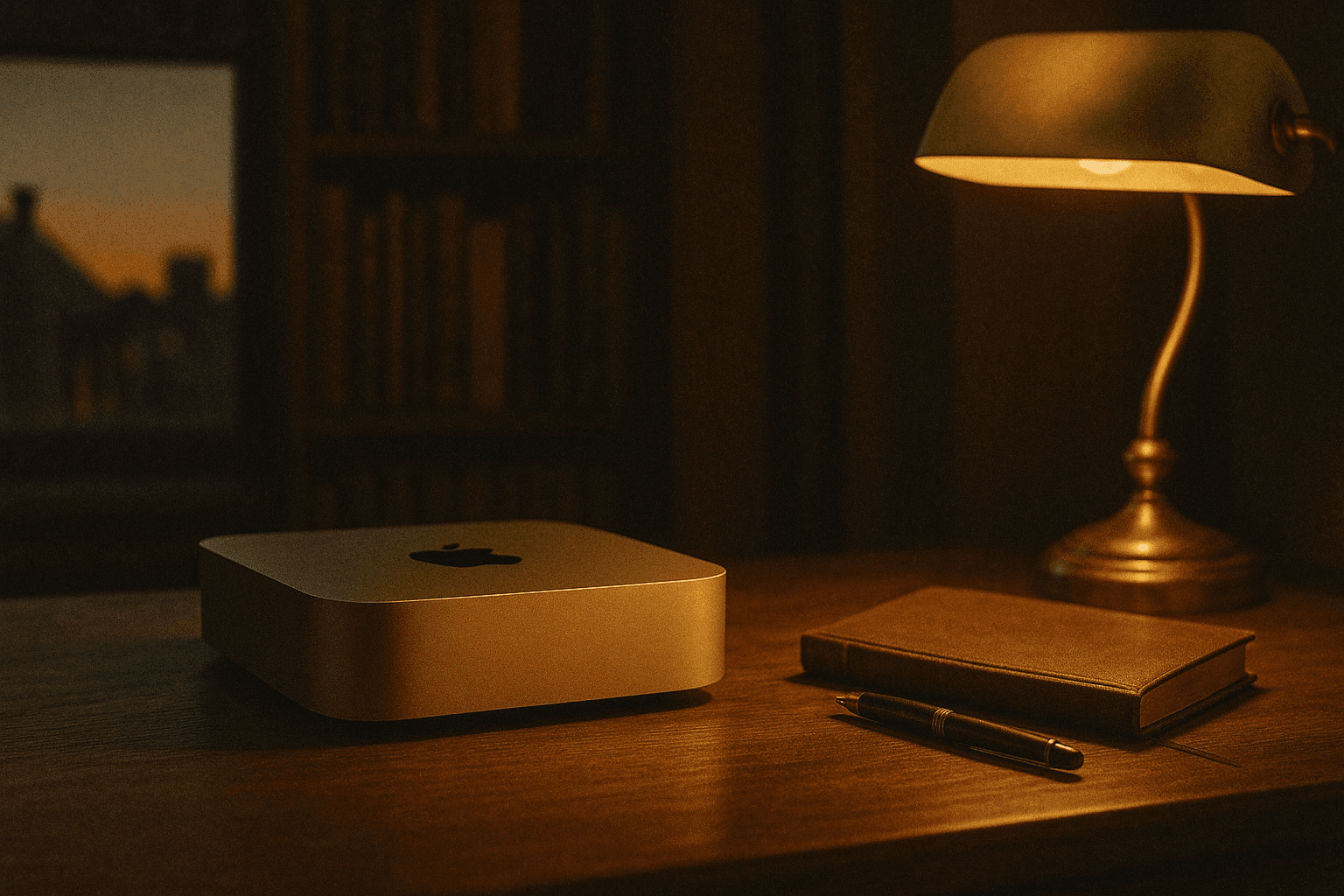
A Mac mini, a Bot, and a Name
A month ago, in Mythos, I told you I'd put a Mac mini in Belgrade and run an always-on AI assistant on it. I promised to report back.
This is the report.
The Mac mini is real. It's running. It has a name—Nikola Tesla.
The name takes a paragraph to explain. I've spent years reading about Tesla. I know his life. I have a sense of how his mind worked. One thing he was famous for: running experiments inside his head before building anything physical. He'd let an invention turn over in his imagination for weeks, watch it from every angle, refine it, stress-test it—and only when it worked there would he reach for tools. The hardware was confirmation.
I wanted that posture in an assistant. Something patient enough to think before acting, useful enough that when it acts, the result is right the first time. I notice this happening already: I describe an idea, we run it through one or two iterations of conversation, and what comes out the other end is not a draft to refine—it's a working thing I keep using. The name became permission for that. Permission to be inventive.
What Nikola is, in plain terms: a long-running Claude session on a dedicated home Mac, reachable through Telegram from anywhere I happen to be, with persistent memory and a small constellation of daemons of his own. Not a chatbot. A colleague.
The Interface Keeps Disappearing
When I started, I only had text. I'd type into Telegram, and Nikola would reply.
Then I added voice. Audio in, text out—he transcribes anything I say, in Serbian or English, often switching mid-sentence, and acts on it.
Then photos and videos. Drop a document into the chat and he reads it. Drop a video and he watches.
Then the most useful change of all. I was driving one morning, thinking how much I wanted to talk to him without taking my hands off the wheel—the way you talk to Siri, but with the depth of a real assistant on the other end. So this morning, with his help, I built two shortcuts on my iPhone. Now I say Hey Siri, send voice to Nikola, speak whatever I need, and he hears me. Driving, walking, cooking, sitting at a café. The phone never has to come out of my pocket.
This is the pattern. Every week, the friction between my intent and his action shrinks. Speaking is easier than typing. A pocket is easier than a desk. The interface keeps disappearing, and what's left underneath is closer to a conversation with a person than anything I've used before.
What He Does
For the past 10 years, one of my morning rituals has been opening the bank statements that arrive in my inbox, pulling out the numbers, and updating a spreadsheet that tells me what cash we have, what's owed, what's coming, what's going. Five or ten minutes a morning. More on the first of the month, when reports are due.
Nikola does this now. He reads the statements, parses them, updates the spreadsheet, and posts a short brief into Telegram with a thorough changelog of what he changed. I read the brief in less time than it used to take me to log into the inbox.
He keeps a calendar I can edit by talking to him. Voice in: "Move Thursday's appointment to Friday at four, and add a half-hour buffer on either side." Done. He won't let me schedule into a dead zone or forget a recurring commitment.
He has a daily routine of his own. A morning report. A midday check that I've started today's plan. A nudge before training. An evening weather brief for the next day. None of it loud—present, in the same chat where I send everything else.
When something arrives I don't want to deal with—a foreign invoice, a contract to skim, a long PDF—I drop it in and it gets handled. The boundary between "incoming document" and "thing I've actioned" used to take half a day. It now takes the time it takes me to forward an email.
The first time I noticed I hadn't re-explained something to him, I felt the weight of how much I re-explain in a normal week. Memory holds. Context holds. He picks up where we left off, every time.
The Architect Wakes at Night
Nikola isn't one personality. He's several.
The Nikola I talk to during the day is one of them. There's also an architect—a separate version of him that wakes up at night, walks through the entire system end to end, checks for security weaknesses, examines the testing posture, suggests improvements. By morning, there's a list of proposals in a quiet corner of the chat. I accept some, decline others, and the system is stronger by breakfast than it was at bedtime.
Even when I'm asleep, Nikola is working on my behalf. The system improves on a schedule I never have to remember.
I'm not throwing pieces together here. I'm building this like an engineer.
A system is only as strong as its weakest link. So each new module has to make the modules around it more useful, not just sit beside them. Memory has to be load-bearing—the things Nikola knows about my work, my projects, the way I want decisions made—so I don't lose Friday's context on Monday morning. Each personality has to know what the others know. Each daemon has to fail safely. Every layer has to carry its weight.
It's slower to build this way than to wire things together quickly and hope. But the slow way produces something that holds, and something every future addition can stand on.
That's the architecture. Quiet, durable, growing.
A Layer Between Me and the Intelligence
Something happened I didn't predict.
For the past two years, I've been used to working directly with AI—opening Claude in a terminal, writing prompts, running Claude Code on a laptop next to me. That's still how I build when I sit down to build.
But Nikola is becoming a layer between me and that intelligence. From my phone, I can ask him to reach into another machine, find a project I was working on last week, wake up the AI session that owns that project, and continue where I left off—all without opening a laptop. He commands instances of the same intelligence I used to command directly.
This is what an assistant for the agent era starts to look like. Not a chatbot you ask things of. A coordinator who mobilizes other agents on your behalf and reports back in plain language, in conversations I keep organized. A direct chat for the everyday flow. A separate space, with its own topics, where bigger threads can branch off and live independently—cashflow in one room, planning in another, engineering in a third—so nothing blurs and nothing gets buried.
Why This Matters Now
The bet I made in Mythos was that always-on agent infrastructure was about to meet a generation of models capable enough to use it well. Already, I'm more certain than I was when I wrote that piece.
The infrastructure side is more buildable than I expected. The model side is delivering. And here's the part that should keep you up at night: when you build a system like this and it works at today's level of capability, every future model release upgrades the entire system. The next Claude. The one after that. They don't replace what I built. They walk into the house I designed and start doing the work better.
“Most people I talk to are still asking whether AI is useful yet. I'm watching my system get more useful by itself.”
Don't Wait to Build the Foundation
If there's one thing I'd repeat from Mythos, it's this: don't wait.
The infrastructure takes time to build well. The compounding only begins once the foundation is laid. The longer you stand on the sidelines, the more ground you cede to the people who started weeks before you.
At Orange Hill, this is exactly the kind of transition we help organizations make. Not slides. Not roadmaps. Working systems—the kind that get more powerful every time a better model drops, while you sleep.
One last thing.
This morning, Nikola wrote the outline of the article you just read. I asked him, by voice, to connect to my work laptop, find the folder where I keep my drafts, read the piece where I first announced him, and sketch a structure for what came next. He did all of it without further input from me. The bones of what you just read came back from him.
The system I built to write about—researched itself, drafted a plan, and handed it back. I expanded what you've read.
Wild times.
Cheers.


Comments
No comments yet.