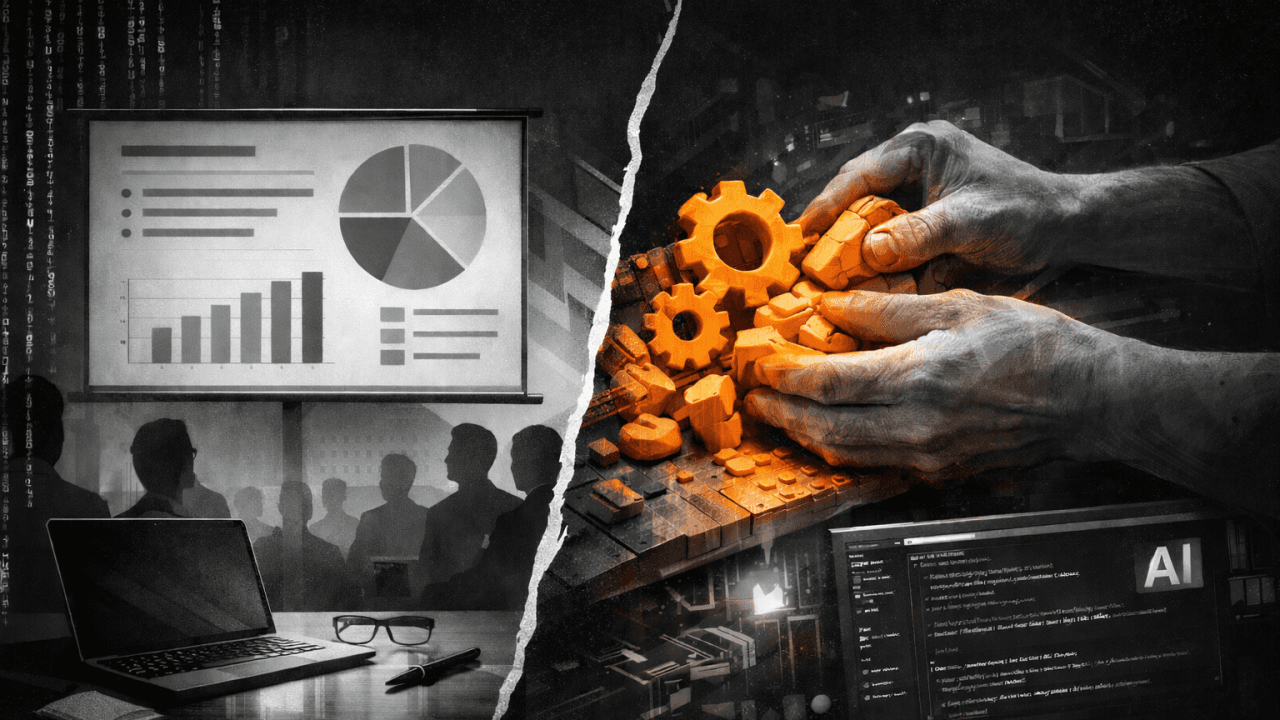
I used to be a good consultant. Slides polished. Research thorough. Recommendations sharp.
And none of it mattered.
I'd walk into a company, spend days understanding their problems, craft a beautiful presentation, deliver it with conviction, answer every question in the room—and then leave. Two weeks later, nothing changed. A month later, they forgot half of what I said. Three months later, they probably hired another consultant to tell them the same things.
Sound familiar? That's because this is how 70 percent of business transformations end. Not with a bang—with a slow fade back to the way things were.
I was part of the problem.
The Conference Effect
You know that feeling. You attend a conference, hear an incredible talk, scribble down notes, feel that rush of "I'm going to change everything when I get back to the office."
Monday morning hits. Slack is on fire. Emails piled up. That big client needs something yesterday. And the inspiration? Gone. Buried under the weight of the same routine you were trying to escape.
The conference effect is what traditional consulting does to companies. It inspires them—temporarily. It informs them—theoretically. And then it leaves them exactly where they found them.
Enterprise AI pilots fail 95 percent of the time. Not because the technology doesn't work. Because teams aren't ready. Because nobody showed them what "ready" looks like. Because some consultant handed them a roadmap and said, "Good luck."
That's not consulting. That's abandonment with a nice font.
The Day I Stopped Talking
The shift happened when I asked myself one question: What if clients could experience AI-driven workflows before the workshop, not after it?
That question changed everything about how I prepare.
I stopped screening clients with "how do you use AI?" and started asking something different: "Tell me about the most painful business processes in your company that AI could automate." That moved the real discovery to before the engagement—not during a workshop where half the room is checking email.
It meant spending a few extra days in preparation. Finding the workflow that hurt the most. Building a working prototype around it—not perfect, not production-ready, but real. Something they could touch, click, use, and feel the moment they walked into the room.
The first time I did this, the room changed.
People who would have politely nodded at slides were leaning forward, pointing at screens, saying, "Wait—can it also do this?" and "What if we added that?" They weren't hearing about a solution anymore. They were holding one. The energy shifted from passive consumption to active creation.
And here's what surprised me most: The clients who experienced prototypes first didn't just engage more during the workshop. They invested more after. More time. More resources. More ambition. Because they'd already felt what was possible—and they wanted more of it.
You Are Neo
Here's something I need you to hear.
Remember The Matrix? Neo sits in that chair, they plug a cable into his head, and seconds later he opens his eyes and says, "I know kung fu."
He didn't study kung fu. He didn't attend a kung fu workshop. He didn't get a 30-slide presentation about the history and philosophy of martial arts. He just...got it. And then he could use it.
You are Neo.
Not metaphorically. Not "kind of." Right now, today, you have access to tools that let you download capabilities you never had before. You don't know how to code? Doesn't matter. Describe what you need in plain English—or Serbian, or German, or whatever your mother tongue is—and AI builds it.
You don't know data visualization? Tell the AI what insights you need and watch a dashboard appear. You can't design a website? Describe it. You've never built an automation? Write down what should happen, step by step, and hand it to Claude Code.
The ultimate programming language of today is your mother tongue.
That shift is the inversion nobody talks about. For decades, execution was the bottleneck. You had an idea? Great—now find a developer, a designer, a data analyst. Wait weeks. Pay thousands. Hope they understood what you meant.
Now? You own the intent. AI owns the execution.
That's not a productivity hack. That's a power shift.
The Sculptor's Hands
But the real magic isn't in the first prototype. It's in what happens after.
When you hand someone a slide deck, they nod. When you hand them a working tool, they start sculpting.
Think about it like clay. A traditional consultant hands you a photograph of what a statue could look like. "Here's our recommendation." You stare at it, maybe pin it to your wall, and eventually forget about it.
A prototype-first consultant puts clay in your hands. You touch it. You feel the shape. You say, "This part needs to be bigger" and "That part doesn't work for how we do things." You start reshaping it. Adding features. Removing friction. Making it yours.
That process is the feedback loop that changes everything. Clients discover requirements they couldn't articulate before—because they couldn't imagine the possibility until they held it. They generate ideas they never would have had staring at a slide. And most critically, they develop ownership. It's no longer "the consultant's recommendation." It's their tool. Their creation. Their competitive advantage.
Nobody fights for a consultant's slide deck. People fight for something they built with their own hands.
Three Levels—and Most of You Are Stuck at One
Let me be direct. There are three levels of AI maturity, and most companies—most people—are stuck at the first one.
Level 1: The Tourist. You use ChatGPT to write emails. Maybe you ask Claude to summarize a document. You've played with image generation. You think you "use AI." You don't. You're sipping cocktails at the hotel bar and calling it travel. You haven't left the resort.
Level 2: The Guided Tour. You've brought in consultants or an internal team that built AI automations for you. Custom GPTs. Workflows that pull from your company data. Real value, real time savings. But you're still dependent. When the automation breaks, you call someone. When you need something new, you wait for the next engagement. You've seen the country, but only through a tour bus window.
Level 3: The Explorer. You build your own. You use agentic AI tools—Claude Code, similar platforms—to create solutions yourself. You write instructions in markdown files, in your own language, and AI executes them. You don't wait for consultants. You don't submit IT tickets. You see a problem on Tuesday and have a working solution by Wednesday. You aren't using AI. You're thinking with it.
Level 3 is where the competitive advantage lives. And it's where almost nobody is—yet.
The gap between Level 1 and Level 3 companies will be the defining business story of 2026. Because while you're waiting for your next consulting engagement, your competitor's sales team is building their own automations over lunch.
The Numbers Don't Lie
The argument isn't philosophical. The data is brutal.
Organizations using prototype-driven, hands-on AI adoption report 80 percent measurable ROI. Harvard found that professionals with AI access work 25 percent faster and deliver 40 percent higher quality. Anthropic's own employees saw their productivity boost jump from 20 percent to 50 percent as they went from casual use to daily integration—experience compounds.
One enterprise customer finished a project estimated at four to eight months in two weeks. TELUS created more than 13,000 custom AI solutions and saved 500,000 hours. Zapier hit 89 percent AI adoption companywide with more than 800 agents deployed internally.
And here's the stat that should keep you up at night: 95 percent of AI pilots fail when companies take the traditional route—buy software, train people on slides, hope for adoption.
The difference between the winners and the 95 percent who fail? The winners stopped presenting and started building.
The Future Belongs to Builders
Here's the truth nobody in traditional consulting wants to admit.
AI doesn't eliminate the need for consultants. It eliminates the excuse for bad consulting. It exposes the fluff—the slide decks, the frameworks that sound impressive but change nothing, the "transformation programs" that transform nothing except your budget into their revenue.
The companies that will win in 2026 and beyond are the ones that stop consuming presentations and start creating prototypes. The ones that stop waiting for someone to show them what's possible and start discovering it themselves.
You don't need another meeting. You don't need another deck. You don't need another roadmap.
You need to put your hands on the clay.



Comments
No comments yet.