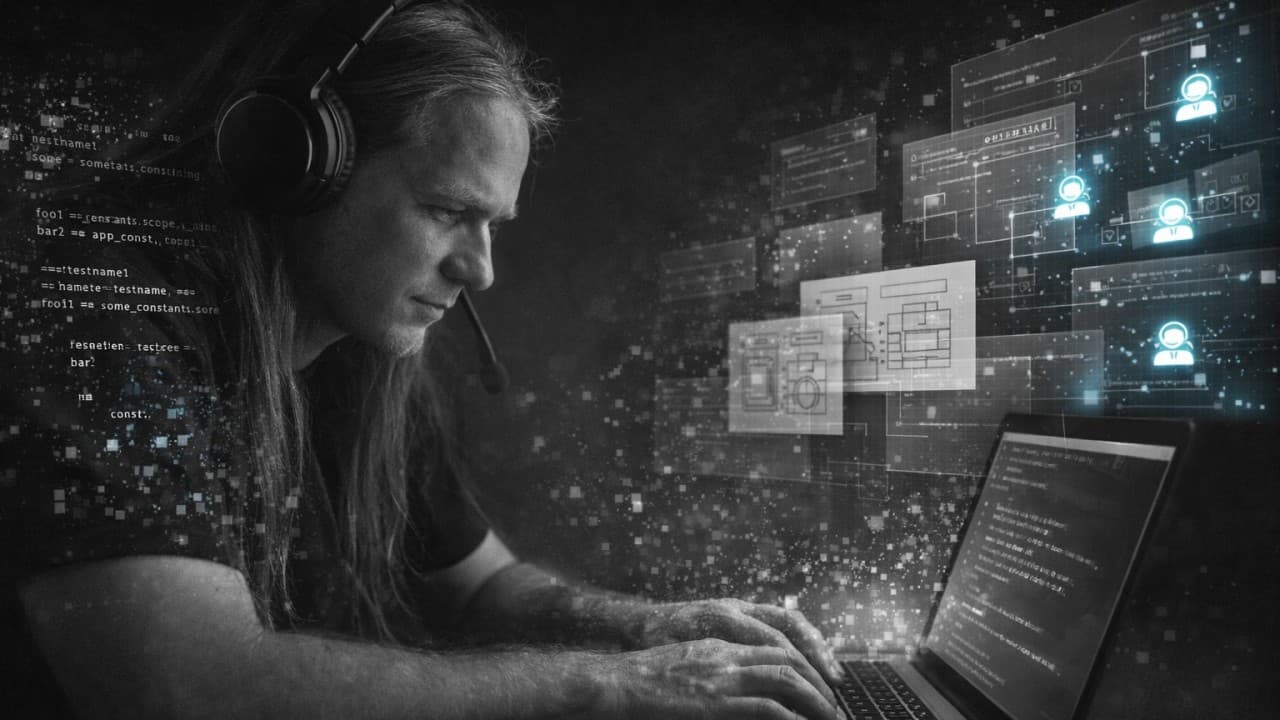
I haven't written a single line of code in six months.
Let that sink in. Me—someone who has poured his heart and soul into software development for more than 15 years. Someone who co-founded the IT Serbia Podcast to champion our dev community. Someone who lived for that feeling—headphones on, deep in the zone, the world fading away as you sculpt logic into something beautiful.
I remember that feeling now with pure nostalgia. Like remembering a place you used to live that no longer exists.
My entire coding today revolves around Claude Code. I don't write software anymore. I describe it. I architect it. I verify it. But I don't write it.
And honestly? That reality makes me sad.
The Year Everything Converges
Various points in AI development are converging faster and faster in 2026. And I think this might be the year we see the end of "software developer" or "coder" as a standalone job altogether.
A recent Stanford study confirmed what many of us have been feeling—young software developers are already losing jobs to AI. In the past two years, companies have eliminated 171,000 IT jobs. Not because the work disappeared, but because AI can do it faster and cheaper. The World Economic Forum now frames developers as "the vanguard of how AI is redefining work"—a polite way of saying we're the first ones through the storm.
For the first time ever, the number of software jobs in the US has stagnated. Salesforce paused hiring engineers. Zuckerberg told Joe Rogan that AI at Meta will soon "be a mid-level engineer." The signals are everywhere.
This Breaks My Heart
I've spent 10 to 15 years building the IT community in Serbia. Running podcasts, organizing events, mentoring developers, watching talented people grow from juniors into architects and tech leads. These are people I care about.
And now, most software developers—as we know them—will face a reckoning this year. Some have already adapted and converted to this new reality. They'll be fine. But many haven't. They'll need to reinvent themselves, find new roles, or switch fields entirely.
It saddens me.
But I'm also enthusiastic about what's emerging. About the human ability to transcend, to elevate above any situation. The disruption is not new. Automation has displaced human jobs before. Factories, switchboard operators, travel agents—every wave of smart automation created more jobs than it destroyed. It's imperative that we all find our footing with these powerful tools that keep emerging with more and more intelligent capabilities.
The Shift: From Writing Code to Writing Specs
Here's what changed.
Ever since Anthropic released Claude Opus 4.5 and integrated it into Claude Code, there's been a fundamental shift in what AI models can do with code. It works.
With earlier models like Sonnet, I had to struggle. Go back, rewrite, fix compilation errors, debug things that almost worked but didn't quite. It felt like pair programming with a talented but unreliable partner.
But with Opus 4.5—man, it works. And it works beautifully.
That shift changed everything at Orange Hill. We moved from what I'd call reactive AI programming—where we used AI to write code but then had to read every line and fix whatever broke—to something fundamentally different.
The paradigm now is spec-driven development.
GitHub coined this term and open-sourced a toolkit for it—its Spec Kit. And it matches what we've been doing organically.
In essence, we now pour all our attention into creating specifications. First on a high level—business requirements, user stories, the "what" and "why." Then we create detailed PRDs—which technology to use, what's the stack, what are the constraints. Then we lay those out into phased specifications that an AI agent can follow step by step to implement the solution.
The Rocket Analogy
Think of it like launching a rocket to the moon.
You have to plan with extreme precision. Because once you launch, if your calculations are off by 0.5 percent, the rocket will head toward the moon but miss it. It will sail right past into empty space.
The same thing happens with AI-driven development. If your spec is off—if you misplan the product or the feature—then AI will build exactly what you described, confidently and beautifully, and miss the mark.
Planning has become everything.
This realization switched us from being software developers to being product architects. What matters now is your inner ability—your intuition, your gut feeling—for what a good product looks like. Whether a user interface solves a problem in as few steps as possible. Whether the experience feels joyful. Whether you've created something useful.
Because if you can tell whether what the AI built is good or not—if you have that product sense—then you will thrive in this new era.
As product architects, our job now is to write specs, read them, verify that the plan is solid—and then hand them to Claude Code. We don't even read the implementation code anymore. It works.
Obviously, you still test that everything functions per spec and that you're happy with the design. But the speed increase is staggering.
Beyond 10x
We used to measure AI productivity gains by a factor of two to 10. That's the number you'd hear at conferences and read in blog posts.
Those numbers are outdated.
Right now, personally, I can deliver a small SaaS product in about a week. And a complex feature that would have taken a full month of traditional development? I can build it in one afternoon.
A developer on DEV Community described a similar experience—getting more than 10 features implemented in a single morning with Opus 4.5, spending time only on code review and specs. This isn't "vibe coding." You still review every change, run your CI/CD pipeline, and understand what ships. It's agent-driven software engineering.
The multiplier isn't 10x anymore. It's something we don't have a good word for yet.
The SaaSpocalypse
But the disruption goes far deeper than developer productivity.
Yesterday—February 3, 2026—Anthropic launched a legal plugin for its Claude Cowork platform. It automates contract review, NDA triage, compliance processes, and legal briefings.
The market reaction was immediate and brutal. A $285 billion rout in software, financial services, and asset management stocks. Thomson Reuters plunged 18 percent—its biggest daily loss on record. RELX dropped 15 percent. Wolters Kluwer fell 13 percent. A Goldman Sachs basket of US software stocks sank 6 percent in a single day—the worst since the tariff selloff in April.
A trader at Jefferies called it the "SaaSpocalypse"—and that name stuck for a reason.
The fear isn't just about legal tech. It spilled over into every SaaS company. Because the underlying terror is clear: Software is becoming so cheap to produce that these companies are losing their moat. Their intellectual property—the code itself—no longer protects them.
Investors aren't selling because they "suddenly discovered AI." They're selling because Anthropic is no longer a model provider—it's stepping into applications and business workflows. And if AI can generate software on demand, what's the value of pre-built software you pay a monthly subscription for?
What's Coming Next
We're at Opus 4.5. And there are strong rumors that Sonnet 5.0—codenamed "Fennec"—is due in the first half of February. Leaks from Vertex AI logs suggest it could match Opus 4.5 on benchmarks while being faster and up to 50 percent cheaper.
More important, it includes a sub-agentic framework—the ability to spawn specialized sub-agents that handle backend work, QA, or research in parallel. A "Dev Team" mode where multiple AI agents collaborate autonomously after receiving a brief.
We don't know what this means in practice. We only know it will make us work even faster. And make our products even better. Maybe even have AI test the code for us—which would be incredible.
But it also signals something even bigger.
Software as a Living Thing
We might be heading toward a world where software isn't pre-built at all.
Imagine software that's written, tested, and executed on the fly—in real time—as you prompt an AI model. You don't need an app. You don't need a subscription. You describe what you need, and the software materializes around your request, runs, delivers the result, and dissolves.
It sounds like science fiction. But after watching $285 billion evaporate from markets in one day because of a single plugin launch, I'd say we're closer to this future than most people think.
Software Development Is Dead. Long Live Software Development.
Software development as we knew it—as I knew it, as I loved it—will cease to exist in 2026.
But a different kind of software development is already emerging. One where the value isn't in typing code but in knowing what to build. Where product intuition matters more than syntax. Where the ability to write a clear spec is more important than the ability to write a clean function.
The developers who thrive will be those who become product architects. Who develop their taste, their judgment, their ability to look at something AI built and say "this is good" or "this misses the point."
The work is still software development. It's a completely different craft now.
And I believe every company that doesn't develop the skill of working with AI agents will be left behind. They'll struggle to keep up with competitors who are faster, cheaper, and—because of AI—delivering work that's so much better.


Comments
No comments yet.